
PIANO PRACTICE TIPS

Piano Practice Can Be Fun Too

Piano practice have fun

Most people don’t really dream of learning the piano. And they certainly don’t dream of practising the piano. They dream of playing the piano.

There’s quite a difference. Playing sounds enjoyable. Practising sounds like work. Perhaps some of that comes from childhood. We have this image of the unfortunate child sitting indoors practising scales while all the other children are outside the window playing football.

But practice doesn’t have to be like that. In fact, once you understand what good practice actually is, it can become one of the most satisfying parts of learning piano.

Playing and Practising Are Two Different Things

If you sit down and play five songs you already know, you’re playing piano. And there’s absolutely nothing wrong with that. It’s what all the practice is ultimately for.

But if there’s one chord change in a song that you always stumble over and you stop and work on that particular change for five minutes, now you’re practising. That’s the difference. Playing is enjoying the skills you already have. Practising is deliberately working on something you can’t quite do yet.

I think a very useful rule is: Practise what you CAN’T play, not what you CAN play.

Obviously you should do both. But if you want to improve, some of your time at the piano needs to take you into slightly unfamiliar territory.

Practice Should Have a Purpose

Before you practise, ask yourself a very simple question: What am I trying to get better at today?

Perhaps you want to change smoothly between three particular chords. Maybe you’re trying to get a left-hand rhythm steady, learn some inversions, remember a few bars of a classical piece or coordinate your two hands. Once you know the answer, practise that.

This sounds obvious, but it’s very easy to spend half an hour at the piano playing things we already know and then wonder why we aren’t improving very quickly. You don’t necessarily need a complicated practice schedule. You just need to know what you’re working on.

Don’t Keep Starting at the Beginning

This is probably one of the biggest wastes of practice time. Suppose you’re learning a piece that’s three pages long. You can play most of it reasonably well, but there’s one horrible little section halfway down page two.

What do many of us do? Start at the beginning. Everything goes beautifully until we reach the horrible bit. We stumble through it, carry on to the end… and then start at the beginning again.

We’ve just spent several minutes practising all the bits we can already play and perhaps ten seconds practising the bit we can’t. Turn that around. Make those difficult few bars your entire practice piece for five minutes. Slow them down, repeat them and work out exactly what’s going wrong.

I’ve written about this in more detail in my article on repetitive practice, but the basic principle is simple: Divide and Conquer. Break difficult things into small pieces and deal with them one at a time.

Make Practice Enjoyable

Good practice doesn’t have to mean scales and exercises. If you’re learning chords, practise them using a rhythm you enjoy. If you’re working on a new left-hand pattern, put some chords underneath it and make it sound like a song. If you’re learning scales, improvise with the notes afterwards.

And if you’re learning a difficult classical passage, enjoy the moment when two bars that seemed completely impossible yesterday suddenly begin to sound like music.

This is something I’ve always tried to build into Pianoforall. Even the early exercises should sound reasonably musical. You’re still repeating movements and building coordination, but there’s no reason it has to sound like punishment. The more musical the exercise sounds, the more likely you are to keep doing it.

Do the Difficult Bit First

If you have twenty minutes to practise, I’d spend the first part on whatever requires the most concentration. Your mind is fresh and you haven’t become frustrated or tired yet.

Work on the awkward chord change, the new rhythm or those troublesome two bars first. Then spend the second half playing something you enjoy.

That way you get both. You’ve moved your playing forward, but you’ve also reminded yourself why you wanted to learn piano in the first place.

Repetition Is Your Friend

There’s no getting around this one. If you find something difficult, you need to repeat it.

Not necessarily fifty times in one sitting. Five careful repetitions today, another five tomorrow and another five the following day can work wonders. When we first try a new movement, it feels awkward because our brain and hands haven’t learned the pattern yet. Repetition gradually makes that movement familiar until eventually we barely have to think about it.

That’s why something that feels impossible on Monday can suddenly feel strangely easy on Thursday. It isn’t magic, although sometimes it feels suspiciously like it.

Don’t Practise for the Neighbours

This is particularly important for adults. If you’re worried about somebody hearing you make mistakes, you’ll play cautiously. You’ll avoid difficult things. You may even wait until nobody is around before practising at all.

That’s hopeless. Practice is where you’re supposed to make mistakes.

If you have a digital piano, headphones are one of the best practice accessories you can buy. Put them on and play that terrible chord change twenty times. Nobody cares.

And if you have an acoustic piano, you’ll simply have to accept that anyone within earshot may occasionally hear the same four bars played rather badly. They’ll survive.

Make It Easy to Sit Down at the Piano

Sometimes the biggest obstacle to practice has nothing to do with music. The keyboard is upstairs in the spare room. The stool is uncomfortable. There’s a pile of books on the keyboard. The laptop with your lessons is in another room. The lighting is poor. Every one of those little things makes it slightly less likely that you’ll practise.

I have a keyboard in my kitchen because that’s where I spend a lot of my time. I find myself sitting down at it for a few minutes while I’m waiting for something to cook or when friends are round. Those little sessions count.

So have a look at your own setup and ask: What is stopping me from sitting down and playing? Then remove as many obstacles as you can. Keep the piano somewhere you’ll see it. Keep it clear. Have a comfortable stool. Keep your iPad or laptop nearby if you’re using an online course.

Make it ridiculously easy to sit down and play for three minutes. Three minutes often turns into ten.

You Can Practise Away From the Piano Too

There will be days when you genuinely don’t have time to sit at the piano. That doesn’t mean you can’t learn anything.

Watch one of your Pianoforall lessons without playing along. Listen carefully to the rhythm. Look at the chord shapes. Notice what the hands are doing. Mental rehearsal is useful too. If you’re learning a chord progression, see if you can picture the chords in your head. If you’re learning a piece, listen to it while following the music.

Obviously, none of this completely replaces putting your fingers on the keys. But learning isn’t confined to the minutes when you’re physically playing.

How Long Should You Practise?

There’s no magic number. Twenty focused minutes can be far more useful than an hour of aimless playing. And if you’re busy, five or ten minutes is infinitely better than deciding you don’t have time for a “proper” practice session and doing nothing.

What matters most is regular contact with the piano. Some days you’ll practise properly. Other days you’ll sit down and play something you enjoy. Occasionally you’ll start playing and discover that nothing seems to work. That’s normal too. Walk away and come back tomorrow.

Learning piano happens over months and years, not one heroic Tuesday evening.

Don’t Forget to Actually Play

There’s a danger at the other extreme too. You can become so obsessed with improving that every time you sit at the piano you’re analysing fingering, correcting mistakes and working on something difficult.

Every now and then, forget all of that. Play the songs you know. Improvise. Put on a rhythm. Sing along. Play something badly and enjoy it anyway.

After all, you didn’t decide to learn piano because you wanted another job. You wanted to play piano.

To Sum Up

Playing and practising are different, and you need a little of both. When you’re practising, have a purpose. Work on the things you can’t yet do. Break difficult sections into small pieces, slow them down and repeat them until they become comfortable.

But don’t turn the piano into a place where you only ever work. Make your setup inviting. Keep the instrument somewhere you can easily reach it. Sit down for five minutes when you have five minutes, and make sure some of your time at the piano is spent simply enjoying what you’ve already learned.

Good practice shouldn’t take the fun out of playing piano. It should give you more and more things that are fun to play.

If you’re just starting and would like some short lessons to practise with, you can try the Free Test Drive and see how Pianoforall builds new skills in small, manageable steps.

Enjoyed this one? Pass it on.
Previous Post
Practice changing mindsets when you sit at your piano
Next Post
John Lennon – Poster Boy

Leave a Reply

Your email address will not be published. Required fields are marked *

Fill out this field
Fill out this field
Please enter a valid email address.

This site uses Akismet to reduce spam. Learn how your comment data is processed.

Blog Home

Recent Posts

Archives

PIANO PRACTICE TIPS

Piano Practice Can Be Fun Too

Piano practice have fun

Most people don’t really dream of learning the piano. And they certainly don’t dream of practising the piano. They dream of playing the piano.

There’s quite a difference. Playing sounds enjoyable. Practising sounds like work. Perhaps some of that comes from childhood. We have this image of the unfortunate child sitting indoors practising scales while all the other children are outside the window playing football.

But practice doesn’t have to be like that. In fact, once you understand what good practice actually is, it can become one of the most satisfying parts of learning piano.

Playing and Practising Are Two Different Things

If you sit down and play five songs you already know, you’re playing piano. And there’s absolutely nothing wrong with that. It’s what all the practice is ultimately for.

But if there’s one chord change in a song that you always stumble over and you stop and work on that particular change for five minutes, now you’re practising. That’s the difference. Playing is enjoying the skills you already have. Practising is deliberately working on something you can’t quite do yet.

I think a very useful rule is: Practise what you CAN’T play, not what you CAN play.

Obviously you should do both. But if you want to improve, some of your time at the piano needs to take you into slightly unfamiliar territory.

Practice Should Have a Purpose

Before you practise, ask yourself a very simple question: What am I trying to get better at today?

Perhaps you want to change smoothly between three particular chords. Maybe you’re trying to get a left-hand rhythm steady, learn some inversions, remember a few bars of a classical piece or coordinate your two hands. Once you know the answer, practise that.

This sounds obvious, but it’s very easy to spend half an hour at the piano playing things we already know and then wonder why we aren’t improving very quickly. You don’t necessarily need a complicated practice schedule. You just need to know what you’re working on.

Don’t Keep Starting at the Beginning

This is probably one of the biggest wastes of practice time. Suppose you’re learning a piece that’s three pages long. You can play most of it reasonably well, but there’s one horrible little section halfway down page two.

What do many of us do? Start at the beginning. Everything goes beautifully until we reach the horrible bit. We stumble through it, carry on to the end… and then start at the beginning again.

We’ve just spent several minutes practising all the bits we can already play and perhaps ten seconds practising the bit we can’t. Turn that around. Make those difficult few bars your entire practice piece for five minutes. Slow them down, repeat them and work out exactly what’s going wrong.

I’ve written about this in more detail in my article on repetitive practice, but the basic principle is simple: Divide and Conquer. Break difficult things into small pieces and deal with them one at a time.

Make Practice Enjoyable

Good practice doesn’t have to mean scales and exercises. If you’re learning chords, practise them using a rhythm you enjoy. If you’re working on a new left-hand pattern, put some chords underneath it and make it sound like a song. If you’re learning scales, improvise with the notes afterwards.

And if you’re learning a difficult classical passage, enjoy the moment when two bars that seemed completely impossible yesterday suddenly begin to sound like music.

This is something I’ve always tried to build into Pianoforall. Even the early exercises should sound reasonably musical. You’re still repeating movements and building coordination, but there’s no reason it has to sound like punishment. The more musical the exercise sounds, the more likely you are to keep doing it.

Do the Difficult Bit First

If you have twenty minutes to practise, I’d spend the first part on whatever requires the most concentration. Your mind is fresh and you haven’t become frustrated or tired yet.

Work on the awkward chord change, the new rhythm or those troublesome two bars first. Then spend the second half playing something you enjoy.

That way you get both. You’ve moved your playing forward, but you’ve also reminded yourself why you wanted to learn piano in the first place.

Repetition Is Your Friend

There’s no getting around this one. If you find something difficult, you need to repeat it.

Not necessarily fifty times in one sitting. Five careful repetitions today, another five tomorrow and another five the following day can work wonders. When we first try a new movement, it feels awkward because our brain and hands haven’t learned the pattern yet. Repetition gradually makes that movement familiar until eventually we barely have to think about it.

That’s why something that feels impossible on Monday can suddenly feel strangely easy on Thursday. It isn’t magic, although sometimes it feels suspiciously like it.

Don’t Practise for the Neighbours

This is particularly important for adults. If you’re worried about somebody hearing you make mistakes, you’ll play cautiously. You’ll avoid difficult things. You may even wait until nobody is around before practising at all.

That’s hopeless. Practice is where you’re supposed to make mistakes.

If you have a digital piano, headphones are one of the best practice accessories you can buy. Put them on and play that terrible chord change twenty times. Nobody cares.

And if you have an acoustic piano, you’ll simply have to accept that anyone within earshot may occasionally hear the same four bars played rather badly. They’ll survive.

Make It Easy to Sit Down at the Piano

Sometimes the biggest obstacle to practice has nothing to do with music. The keyboard is upstairs in the spare room. The stool is uncomfortable. There’s a pile of books on the keyboard. The laptop with your lessons is in another room. The lighting is poor. Every one of those little things makes it slightly less likely that you’ll practise.

I have a keyboard in my kitchen because that’s where I spend a lot of my time. I find myself sitting down at it for a few minutes while I’m waiting for something to cook or when friends are round. Those little sessions count.

So have a look at your own setup and ask: What is stopping me from sitting down and playing? Then remove as many obstacles as you can. Keep the piano somewhere you’ll see it. Keep it clear. Have a comfortable stool. Keep your iPad or laptop nearby if you’re using an online course.

Make it ridiculously easy to sit down and play for three minutes. Three minutes often turns into ten.

You Can Practise Away From the Piano Too

There will be days when you genuinely don’t have time to sit at the piano. That doesn’t mean you can’t learn anything.

Watch one of your Pianoforall lessons without playing along. Listen carefully to the rhythm. Look at the chord shapes. Notice what the hands are doing. Mental rehearsal is useful too. If you’re learning a chord progression, see if you can picture the chords in your head. If you’re learning a piece, listen to it while following the music.

Obviously, none of this completely replaces putting your fingers on the keys. But learning isn’t confined to the minutes when you’re physically playing.

How Long Should You Practise?

There’s no magic number. Twenty focused minutes can be far more useful than an hour of aimless playing. And if you’re busy, five or ten minutes is infinitely better than deciding you don’t have time for a “proper” practice session and doing nothing.

What matters most is regular contact with the piano. Some days you’ll practise properly. Other days you’ll sit down and play something you enjoy. Occasionally you’ll start playing and discover that nothing seems to work. That’s normal too. Walk away and come back tomorrow.

Learning piano happens over months and years, not one heroic Tuesday evening.

Don’t Forget to Actually Play

There’s a danger at the other extreme too. You can become so obsessed with improving that every time you sit at the piano you’re analysing fingering, correcting mistakes and working on something difficult.

Every now and then, forget all of that. Play the songs you know. Improvise. Put on a rhythm. Sing along. Play something badly and enjoy it anyway.

After all, you didn’t decide to learn piano because you wanted another job. You wanted to play piano.

To Sum Up

Playing and practising are different, and you need a little of both. When you’re practising, have a purpose. Work on the things you can’t yet do. Break difficult sections into small pieces, slow them down and repeat them until they become comfortable.

But don’t turn the piano into a place where you only ever work. Make your setup inviting. Keep the instrument somewhere you can easily reach it. Sit down for five minutes when you have five minutes, and make sure some of your time at the piano is spent simply enjoying what you’ve already learned.

Good practice shouldn’t take the fun out of playing piano. It should give you more and more things that are fun to play.

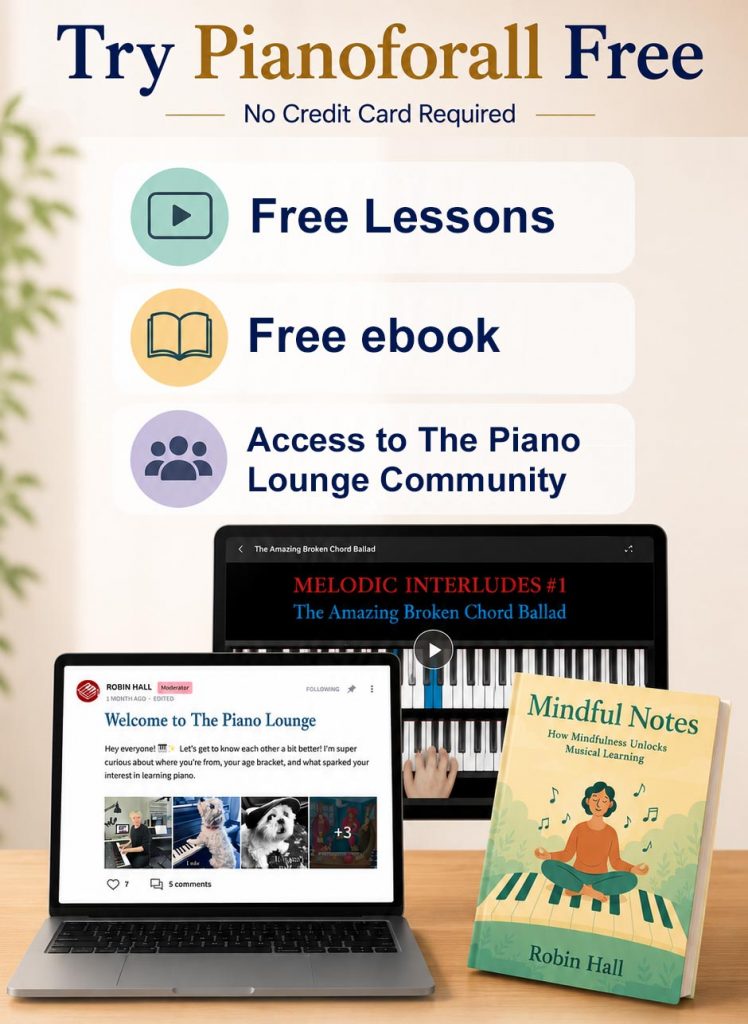
If you’re just starting and would like some short lessons to practise with, you can try the Free Test Drive and see how Pianoforall builds new skills in small, manageable steps.
Previous Post
Practice changing mindsets when you sit at your piano
Next Post
John Lennon – Poster Boy

Leave a Reply

Your email address will not be published. Required fields are marked *

Fill out this field
Fill out this field
Please enter a valid email address.

This site uses Akismet to reduce spam. Learn how your comment data is processed.

Blog Home

Recent Posts

Archives