Can You Really Learn Piano Online as a Complete Beginner?
Yes. You don’t need any previous musical experience or any special talent to start learning piano.
A good online course has one big advantage — you can learn at your own pace and repeat lessons as often as you need to.
With Pianoforall, you start by learning a few simple chords and rhythms so that you can begin making music straight away. Reading and theory are introduced gradually as you progress.
The First Step: Chords
Why start with chords?
Chords are the building blocks of most music. Once you know a few simple chord shapes and rhythms, you can use them to play hundreds of songs.
It’s much the same as learning guitar. You don’t need to know every note on the instrument before you can play a song. A few chords and a simple rhythm are enough to get you started.
In this video, I explain how Pianoforall uses chords to get you playing from the very beginning.
This simple progression already sounds like music.
From here, Pianoforall introduces some of the most common rhythm patterns used in popular music. You start with a few simple chords and learn different ways to play them. Then, with each new exercise, you add something new to what you can already do, gradually making your playing sound more complete.
As you progress, you’ll move on to blues and jazz patterns and start doing some simple improvisation.
Understanding chords also makes classical music much easier to learn. Chords are often hidden within the patterns and melodies of classical pieces, so recognising the underlying chord shapes can make much more sense than trying to memorise hundreds of individual notes.
The trailer video below shows some of these rhythms in action.
Online or Private Lessons: Which Is Better?
Both can work very well. It really depends on how you prefer to learn.
A good private teacher can give you immediate feedback, correct mistakes and adapt lessons to suit you. The disadvantages are the ongoing cost, having to arrange lessons at a particular time and the fact that many teachers still use fairly traditional teaching methods.
Online courses give you much more flexibility. You can learn whenever you have time, repeat lessons as often as you like and progress at your own pace. They are also usually much less expensive than private lessons.
Some people use both — learning mainly online and having an occasional private lesson when they feel they need some extra help.
Is YouTube Enough?
There are some excellent piano lessons on YouTube, and it can be very useful if you want to learn a particular song or find an answer to a particular problem.
The difficulty for a complete beginner is knowing what to learn next.
One video might teach you some chords, another a scale and another a particular song, but there isn’t necessarily any connection between them.
I think beginners learn much better with a structured course where each lesson builds on what they’ve already learned. You can still use YouTube whenever you want, but you have a clear path to follow.
How to Choose an Online Piano Course
If you’re looking at online courses, I would look for one that offers:
- Short lessons that you can easily repeat
- A clear step-by-step structure
- The chance to start playing music early
- Good visual demonstrations and explanations
- A combination of playing by ear and learning to read music
- Plenty of opportunities to practise what you’ve just learned
- Help when you get stuck
- The ability to go back and review earlier lessons whenever you like
Pianoforall was designed around many of these ideas, particularly for adult beginners.
Why Pianoforall Works Well for Beginners
You start with chords. A few simple chords and rhythms allow you to start making music almost immediately. It’s similar to the way many people learn guitar — a few chords and a simple strumming pattern can take you a surprisingly long way.
Reading is introduced gradually. You begin mainly by listening, watching and playing. Written music is introduced as you progress, so it relates to music you already understand.
Each lesson builds on the last. The course is very carefully structured. You start with something simple and each exercise adds another skill or idea. Over time, those skills come together and can be applied to all kinds of music.
You learn different styles. You’ll gradually move through pop, ballads, blues, jazz and eventually classical music, picking up different rhythms, chord patterns and techniques along the way.
The lessons are short. You can learn in small amounts of time and repeat anything you haven’t quite understood.
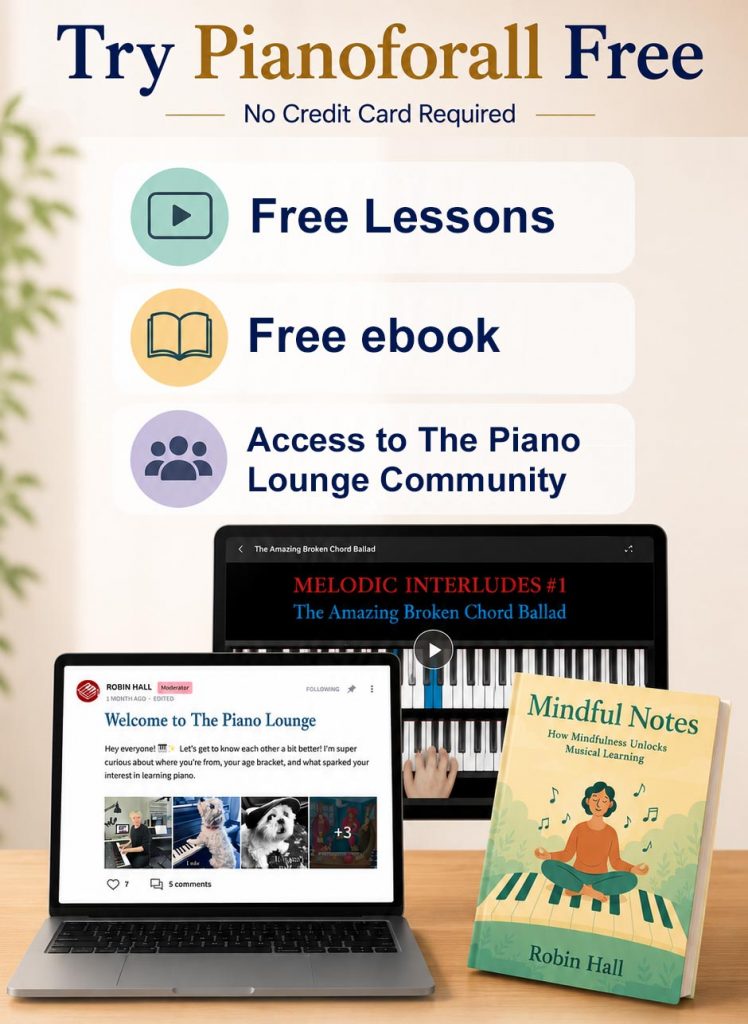
There’s help available. You can ask questions when you get stuck, and The Piano Lounge gives you a place to meet and chat with other Pianoforall students.
How Much Should You Practise?
You don’t need to practise for hours every day.
For a beginner, I think 15–20 minutes on most days is a very good place to start. Regular practice is much more useful than doing one long session and then leaving the piano untouched for a week.
As you progress, you may naturally find yourself playing for longer — particularly when you’re enjoying what you’re learning.
I wouldn’t give precise promises about what you’ll be able to play after two weeks, three months or six months. Everyone learns at a different pace.
What matters is that you’re making steady progress and, most importantly, enjoying playing the piano.
Do You Need to Read Music?
Not at the beginning.
One of the main ideas behind Pianoforall is play first, read later.
It’s a little like the way we learn language as children. We learn to speak long before we learn to read and write.
With Pianoforall, you start by listening, watching and playing. Reading music is then introduced gradually, when the sounds and patterns on the page already have some meaning.
That doesn’t mean reading music isn’t important. It simply means you don’t have to master it before you’re allowed to enjoy playing the piano.
What You’ll Learn in Your First Months
As you work through the course, you’ll gradually learn:
- The most useful chords and how to move easily between them
- A variety of rhythm patterns that you can use with hundreds of songs
- Broken chords, fills and simple melodies
- How to put these different skills together to play complete songs
- How to start improvising using just a few notes
- The basics of reading music, introduced gradually as you progress
- How to practise effectively and make the most of the time you have
Each new exercise builds on what you’ve already learned, so you’re not simply learning individual songs. You’re gradually building a collection of skills that you can use with any song you want to play.
Your step-by-step path
Start sounding good fast, then expand into blues, jazz, improv and smart reading.
Rhythm-Style Foundations
Start with some of the most useful chords and learn a variety of rhythm patterns that you can use with hundreds of songs.
Ballad Style
Learn flowing broken-chord patterns and gradually add melody notes and fills.
Blues & Rock ’n’ Roll
Learn 12-bar blues, blues rhythms, riffs and some classic rock ’n’ roll patterns.
Jazz
Learn some simple jazz chord shapes and rhythms, and start experimenting with improvisation.
Playing by Ear & Improvising
Learn how to work out chords and melodies by ear and how to improvise using notes that fit naturally with the chords.
Reading Music
Reading is introduced gradually, starting with rhythm and basic notation and building from there as your playing develops.
See what’s included →
| Prefer classical?
Satie ·
Bach ·
Moonlight
How Long Does It Take to Learn Piano?
Everyone learns at a different pace, so I don’t think it’s particularly helpful to say that you should reach a certain standard in six months or a year.
What matters much more is regular practice. Even 15–20 minutes on most days can make a big difference, and as you improve and start enjoying your playing, you’ll probably find yourself practising for longer anyway.
Before you begin, it’s also worth making sure you have a suitable keyboard or piano and somewhere comfortable to play it.
Keyboard or Piano? What Do You Need?
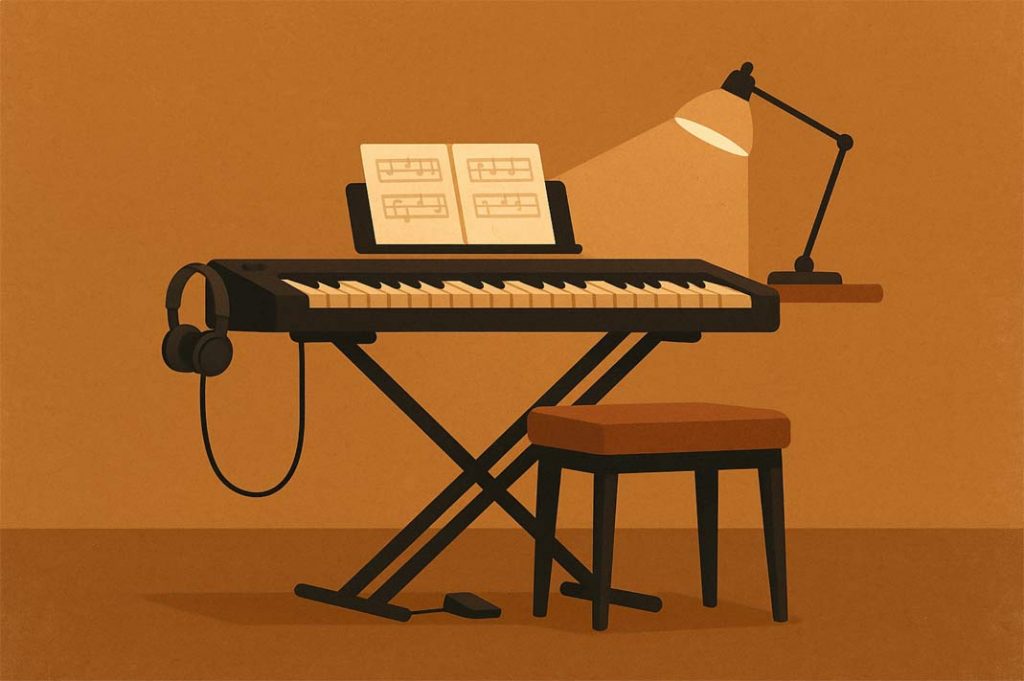
You don’t need an expensive instrument to start learning, but there are a few things I would recommend:
- At least 61 full-size keys. 76 or 88 keys are even better.
- Touch-sensitive keys. This is important because it allows you to play louder or softer depending on how you press the keys.
- Weighted or semi-weighted keys if your budget allows.
- A sustain pedal. Make sure the keyboard has a socket for one.
- A good, stable stand and an adjustable stool or seat.
- A headphone socket is very useful, particularly if you want to practise without disturbing anyone.
Do you need lots of keyboard functions?
No. Hundreds of different sounds and functions aren’t particularly important for learning piano.
I’d concentrate on finding a keyboard that feels comfortable to play and has a good piano sound.
Built-in rhythms can be useful and fun, though, particularly when you’re learning different rhythm styles.
Digital or acoustic piano?
Both are perfectly good for learning.
A digital piano has some practical advantages. You can use headphones, it doesn’t need tuning and it usually takes up less space.
An acoustic piano is lovely to play if you have the room for one, but you certainly don’t need one to learn.
Read my guide to choosing a keyboard or digital piano
Sitting Comfortably at the Piano
Try to sit at a height where your forearms are roughly level with the keyboard and your wrists can remain relaxed.
Keep your shoulders relaxed too. If you notice yourself becoming tense, stop for a moment, loosen your hands and shoulders and then start again.
It also helps to leave your keyboard set up and ready to play if you can. You’re much more likely to sit down for ten minutes if you don’t have to get everything out first.
If You Had Piano Lessons as a Child
You may be surprised by how much comes back to you.
But it doesn’t matter if you’ve forgotten everything, or if you’ve never played a piano before. Pianoforall starts from the beginning.
Do You Need Musical Talent?
No.
Playing piano is a collection of skills, and those skills can be learned gradually.
Some things will come easily and others will take a little longer. That’s perfectly normal. The important thing is to give your hands and brain enough time to get used to each new skill before moving on.
Some Simple Practice Advice
- Practise regularly. Fifteen or twenty minutes on most days is much better than one long session every week.
- Slow things down. If something is difficult, practise it slowly until it starts to feel comfortable.
- Practise small sections. You don’t always need to play a piece or exercise from beginning to end. Work on the bit that’s causing the problem.
- Don’t rush ahead. The Pianoforall lessons are carefully structured so that each new skill builds on what you’ve already learned.
- Stay relaxed. If you notice tension in your hands, arms or shoulders, stop for a moment and loosen up.
- Be patient. Some things seem impossible at first and then suddenly become much easier after a few days of practice.
- Enjoy what you’re playing. That’s rather important. It’s the reason you’re learning piano in the first place.
Learning Piano Later in Life
Learning piano involves listening, movement, memory and concentration, all at the same time.
But I wouldn’t learn piano because of claims that it will make you cleverer or improve your brain. Learn because you want to play music.
If it also gives you something enjoyable to concentrate on, helps you relax and gives you the satisfaction of learning a new skill, all the better.
Beginner FAQs
Am I too old to start?
No. Adults often learn faster than they expect because they can focus and practise regularly.
How much will I need to practise?
Start with 15–20 minutes a day, 5 days a week. Increase to 20–30 minutes as it gets easier.
How quickly will I be able to play for friends?
Often within 2–3 months at a relaxed tempo, if you follow a chord‑first method and practise steadily.
Do I need to read music?
Not at the start. You can learn by ear and add reading gradually.
Is 61 keys enough?
It can work briefly. 88 keys (full size) are strongly recommended for long‑term progress.
What about subscriptions?
Subscriptions can work, but a one‑time course with lifetime access removes pressure and lets you learn at your pace.
Do I get help if I’m stuck?
Yes. Use the course Q&A/comments or email to ask questions. You can also share a short clip to describe an issue.
Next Steps
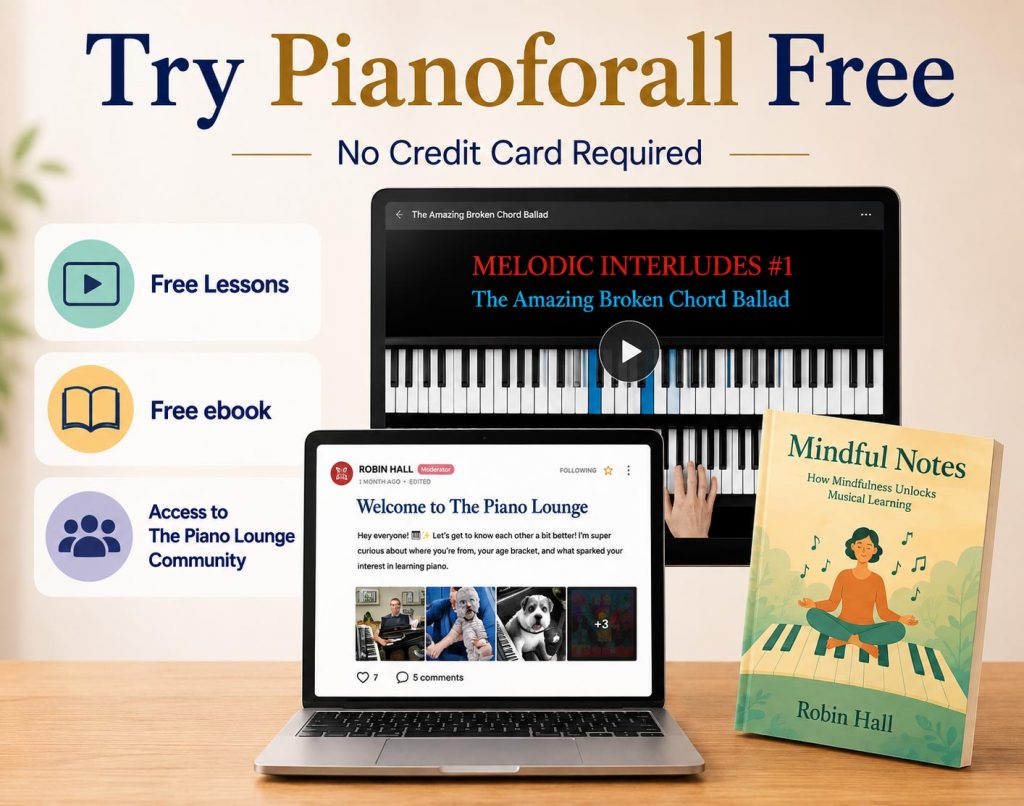
- Try a free lesson and sample eBook: Free Test Drive.
- When ready, start here: Pianoforall: Learn Piano by Ear.
- Prefer classical pieces taught by ear? Satie • Bach Preludes • Moonlight Sonata (1st Mvt)
Blogger, teacher, or creator? Partner with us.