Frequently Asked Questions

If you have a question about Pianoforall, Classics By Ear, choosing a course, what equipment you need or how everything works, you should find the answer here.

If you’re still not sure about anything, you can always email me at robin(at)pianoforall.com. I read and answer my emails personally.

Choosing a Course

If you want a complete piano course, start with Pianoforall. It’s our signature course, taking you from the very beginning through chords, rhythm styles, ballads, blues, jazz, improvisation, playing by ear, reading music and classical piano.

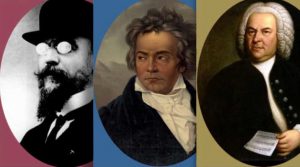
Classics By Ear is for anyone who has always wanted to play some of the world’s best-loved classical pieces but thought they might be beyond them. Each course focuses on the music of a particular composer, breaking each piece down into small, carefully structured steps. We work through the music bar by bar using video, keyboard diagrams, cheat sheets, patterns, chords and written music.

You can start with either, or work through Pianoforall and Classics By Ear alongside each other. That way you can develop your general piano skills while also learning a classical piece you’ve always wanted to play.

No, although the skills you learn in Pianoforall will certainly help.

Classics By Ear is carefully designed so that you can start with one of these courses if there’s a particular classical piece you’ve always wanted to play. Everything is broken down into small steps and we use several different ways of learning and remembering the music rather than relying on sheet music alone.

If you’re a complete beginner, you can also work through Pianoforall at the same time. The two work very well alongside each other.

If you only want Pianoforall or one particular Classics By Ear course, buy it individually.

If you’d like all three Classics By Ear courses, there’s a Classics By Ear Bundle.

Or, if you’d like Pianoforall and all three Classics By Ear courses, the Complete Bundle gives you all four.

Learning With Pianoforall

Yes. Pianoforall was designed with complete beginners in mind and assumes you know nothing about piano or music.

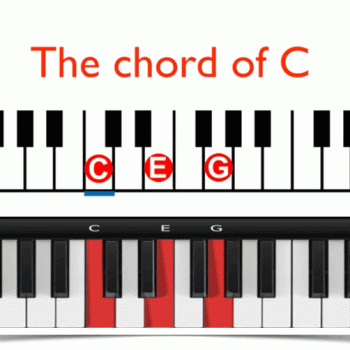
We start with simple chords and rhythms and build everything in carefully structured small steps. Each exercise adds something new, so you gradually build up a collection of skills, patterns and techniques that you can use to play all kinds of music.

I’ve taught students of all ages, including many people who started learning after retirement.

Adults often make very good students. You know the kind of music you enjoy, you’re good at recognising patterns and, most importantly, you’re learning because you want to.

You don’t need hours of practice either. A little regular practice can take you a surprisingly long way.

Yes. In fact, returning players often find Pianoforall particularly useful because it may be quite different from the way they originally learned.

If you already know some of the basics, you can move through those sections quite quickly. But I’d still start at the beginning because you’ll pick up the chord shapes, rhythm patterns and way of thinking that we build on later.

You may also be surprised by how much comes back.

No — not to begin with.

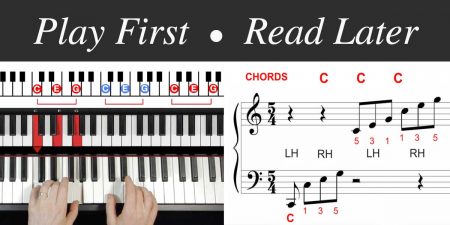
My approach has always been Play First, Ask Questions Later.

You’ll start mainly by listening, watching and playing chords and rhythms. Reading music is then introduced gradually as you progress.

By the time you see something written on the page, there’s a good chance you’ve already heard it and played it, which makes the notation much easier to understand.

Many people who learned piano traditionally can read music quite well but find it difficult to sit down and simply play without a score.

Pianoforall approaches the piano from another direction. You’ll learn chords, rhythm patterns, accompaniment styles, blues, jazz, improvisation and playing by ear.

Most importantly, you’ll learn skills and patterns that you can apply to other songs rather than simply learning individual pieces.

Yes. It’s an important part of Pianoforall.

You’ll gradually learn to recognise chords, chord progressions, rhythms and common musical patterns and begin to understand how they fit together.

The aim is to give you skills you can apply to all kinds of music, so eventually you can sit down at a piano and simply play rather than always needing sheet music in front of you.

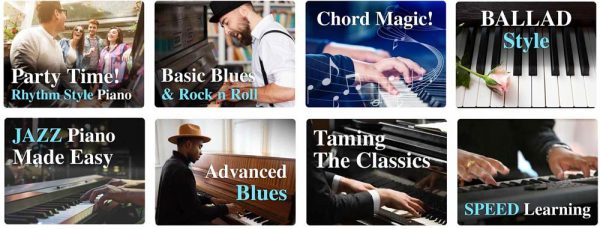
Pianoforall starts with chords and rhythm-style piano and gradually moves through ballads, blues, rock ’n’ roll, jazz, improvisation, playing by ear, reading music and classical piano.

Each section builds on things you’ve already learned, so you’re continually adding new skills rather than starting again from scratch.

You don’t need to practise for hours.

Fifteen or twenty minutes regularly is much better than forcing yourself through a long session once a week.

Particularly at the beginning, short sessions give your hands and brain time to get used to unfamiliar movements. If you’re enjoying yourself and want to play for longer, of course you can.

You don’t need an expensive piano.

A keyboard with at least 61 full-size, touch-sensitive keys is enough to get started. If you have the budget and space, an 88-key weighted digital piano is even better.

The important thing is touch sensitivity — when you play a key harder it should sound louder, and when you play it gently it should sound softer.

I also strongly recommend a sustain pedal. It makes an enormous difference to the sound of your playing.

You don’t need a MIDI keyboard or any special connection between your keyboard and Pianoforall.

Access, Downloads & Support

You get instant access to your courses through Pianoforall Academy. There’s nothing to download or set up — simply sign in on your computer, tablet or phone and start learning.

All the videos and course material are there ready to use, and your progress is saved automatically. You’ll also have instant access to The Piano Lounge community, where you can ask questions, get help and chat with other students.

You can even screen-share to your TV if you’d prefer to watch the lessons on a larger screen.

If you’d like to see just how simple it is before you buy anything, try the Free Test Drive. It gives you access to the same Academy, so you can try a lesson, watch the videos and visit The Piano Lounge for yourself. I’ll meet you in there 🙂

You have lifetime access to the courses you buy.

There’s no deadline and no need to rush. If life gets in the way and you stop for a while, simply come back when you’re ready.

Any future updates to your course are included too.

You can email me directly and I’ll be happy to help. I read and answer my emails personally.
You’ll also have access to The Piano Lounge, our community of Pianoforall students from around the world.

It’s a friendly place to ask questions, get help, share your progress or simply chat with other people who enjoy learning and playing piano. I’m part of the community too, so I’ll be around to help when I can.

Buying & Trying Pianoforall

No.

All the courses are a one-time purchase with lifetime access. There are no monthly subscription fees.

You can buy an individual course or choose one of the bundles if you’d like several courses.

Yes.

The Free Test Drive lets you look inside Pianoforall Academy and try some of the material before deciding whether it’s right for you.

You can try a Pianoforall lesson, download the Mindful Notes ebook, watch trailers for Pianoforall and Classics By Ear and join The Piano Lounge.

There’s no credit card required.

Yes.

All purchases come with a 60-day money-back guarantee.

If you try a course and decide it isn’t right for you, you can ask for a refund.