Why Most Piano Courses Expect Too Much from Beginners
I’ve been teaching piano for over 30 years, and one thing I’ve learned is that it’s very easy to expect too much from a complete beginner.
In fact, I sometimes forget myself.
Then I watch someone who has never touched a piano before struggling to play a basic C chord and I’m reminded just how difficult those first steps can be.
Finding the notes. Using the correct fingers. Playing three notes together. Moving to another chord. Keeping a steady rhythm. And then asking two hands to do completely different things at the same time.
None of those things seems particularly difficult once you can do them.
But to a complete beginner, they are.
You’re learning a new language and asking your fingers and hands to make completely new shapes and movements.
And I think this is where many piano courses get the early stages wrong.
Learning Songs Isn’t the Same as Learning Piano
Most online piano courses promise you the dream — your dream — of being able to sit down and play the piano.
And of course, that’s what I want for you too.
One way to give a beginner an impressive result quickly is to teach them a particular song. Show them where to put their fingers and which notes to play, and with enough repetition they may be able to play it surprisingly well.
There’s nothing wrong with that. Learning songs is part of learning piano.
But learning a handful of songs isn’t necessarily the same as learning how to play the piano.
It’s a bit like learning a foreign language by memorising a poem. You might be able to recite it perfectly, but that doesn’t mean you can have a conversation.
I think learning music is much the same.
I’d rather teach you the musical equivalent of words and sentences — chords, rhythms, patterns, scales, progressions and the way they fit together.
Then when you come across a new song, you start recognising things.
I know that chord.
I’ve played that rhythm before.
That left-hand pattern is familiar.
That’s when you begin to move from copying music to actually understanding and playing it.
You Have to Get Past the Pain Barrier
I don’t mean you should ever play through actual pain. I’m talking about that initial barrier of awkwardness and frustration that comes with learning almost any new physical skill.
When playing piano has been a dream for years, finally sitting down at a keyboard can be surprisingly disappointing.
You imagined music coming out.
Instead, your fingers won’t behave themselves. Your wrists get tired. You keep hitting the wrong notes. Your chords don’t sound anything like the ones I’m playing on the video.
You may sound less like Elton John and more like a child bashing away at a toy piano.
And that’s when the doubts begin.
Maybe I’m just not musical.
Maybe I’m too old.
Perhaps piano isn’t for me.
This is the point where a lot of people give up. They miss a day’s practice, then another, and before long the lovely new keyboard is sitting in the corner gathering dust.
The First Few Wins Change Everything
If only I had a magic wand that could take every beginner past that first awkward stage.
Because something very interesting happens on the other side of it.
You manage to change between a few chords without stopping.
You get a rhythm going with both hands.
You play something that actually sounds quite good.
Maybe you recognise it as a real song. Perhaps you even sing along.
Or someone hears you and says:
“Hey, I didn’t know you played piano.”
That little moment can make an enormous difference.
Because now you have evidence that you can do it.
Once you can play a few things that sound good, you want to learn another rhythm. Another song. Another chord.
You start to believe you can play piano.
And practice becomes something you look forward to rather than something you keep putting off until tomorrow.
I’ve Seen People Fall at the First Hurdle
Over the years I’ve had lots of friends tell me they would love to play piano.
Naturally, I give them Pianoforall.
I know the course works. But I’ve also watched some of those friends fall at the very first hurdle.
Their fingers feel awkward. It doesn’t immediately sound the way they hoped. And they stop.
Sometimes I want to shake them and say, Just keep going a little longer!
Not for six months. Not even necessarily for six weeks.
Just long enough to get those first few movements into your fingers and experience one or two small successes.
Because everyone who can play piano has been through that awkward stage.
There isn’t a special group of people who sat at a piano for the first time and discovered that their fingers already knew what to do.
We all had to teach them.
Forget About Being ‘Musical’ for a While
If you’re struggling at the beginning, forget for a moment about whether you’re musical.
Think of it more like learning to juggle.
Initially you’re simply trying to teach your hands a new pattern. You’ll drop the balls constantly, but you don’t conclude that you have no juggling talent. You pick them up and try again.
The early stages of piano can be approached in much the same way.
Find the chord.
Put your fingers in position.
Play it.
Move to the next chord.
Do it again.
You can understand an exercise perfectly and still not be able to play it. Your fingers need repetition before the movement becomes familiar.
Give your hands a chance to learn.
The music will come.
Why Pianoforall Uses Such Small Steps
This is why the early Pianoforall lessons are broken down into very small, carefully planned steps.
I start from the beginning and assume you know nothing.
We might learn a simple chord shape.
Then use that chord in a basic rhythm.
Then change between two chords.
Then use those same chords with a different rhythm.
Then perhaps add a note, a right-hand pattern or a new way of using the left hand.
You’re not continually being given completely new things to remember. You’re taking something that’s beginning to feel familiar and adding one small ingredient.
Over time, those ingredients build into quite a large collection of musical skills.
And this becomes particularly important when you start playing with two hands.
You may get the right hand working perfectly and the left hand working perfectly — then put them together and suddenly neither hand appears to know anything.
That’s normal.
Go back. Practise each hand separately. Put together a tiny section. Repeat it slowly. Then add a little more.
There’s no benefit in struggling through sixteen bars badly when the real problem is contained in the first two.
Repetition Doesn’t Have to Be Boring
You need repetition if you want your hands to learn, but there’s an obvious problem.
Repetition can be boring.
If I give you a dull finger exercise and tell you to play it 100 times, there’s a reasonable chance the piano and I will both have lost you by lunchtime.
So one of the things I spent a lot of time developing in Pianoforall was interesting ways to repeat the same basic skills.
You might practise a chord change in one rhythm and then use the same chords in another.
You might take a simple progression and turn it into a ballad.
Later, the same understanding of chords helps with blues, jazz, improvisation and even classical music.
You’re repeating and strengthening the underlying skills, but you’re making music at the same time.
I’ve always felt that even the simplest beginner exercise should sound as much like music as possible.
Why I Start With Chords
This is also why Pianoforall starts with chords.
Think about someone learning guitar. Nobody finds it strange that a beginner might learn a few chords and a basic strumming pattern and immediately start using them to accompany songs.
Piano can be approached in much the same way.
Learn a few useful chord shapes.
Learn how to move between them.
Add a simple rhythm.
Suddenly you’re making music.
And those chords don’t disappear when you move on. You’ll meet them again and again in pop, ballads, blues, jazz and classical music.
You’re gradually learning the building blocks underneath the music.
Reading Music Makes More Sense Later
Traditional piano teaching often starts with written music.
I do teach reading in Pianoforall, but I prefer to introduce it after you’ve already spent some time playing.
If you’ve already played a chord, heard it and become familiar with its shape on the keyboard, seeing it written down has some meaning. You’re connecting the notation with something you already know.
It’s rather like the way children learn to speak before they learn to read and write. When they eventually see a familiar word written down, the word already means something to them.
That’s the thinking behind my Play First, Ask Questions Later approach.
Play it. Hear it. Get a feel for it.
Then let’s look at why it works and how it appears on the page.
Make It Easy to Practise
There’s another part of learning piano that doesn’t get talked about enough.
Where is your keyboard?
If it’s in the attic, folded away in a cupboard, covered with books and papers, or requires ten minutes of rearranging furniture before you can play it, you’re making practising unnecessarily difficult.
The same applies if you don’t have headphones and feel you can only practise when nobody else is around to hear your mistakes.
Try to make sitting down at the piano as easy as possible.
Keep the keyboard somewhere you naturally spend time. Leave it set up and clear of clutter. Have decent lighting. Keep your headphones nearby and your iPad or laptop ready for the Pianoforall lessons.
Ideally, you should be able to sit down and start playing within seconds.
I have a keyboard in my kitchen because I spend a lot of time there.
Because it’s there, I find myself sitting down at it at odd moments — waiting for a pizza to cook, while the kettle boils, or when friends are round.
Practising doesn’t always have to mean announcing, Right, I shall now practise piano for half an hour.
Three minutes counts.
A few chord changes count.
Playing yesterday’s rhythm once counts.
Those little encounters with the piano add up, and they make playing part of ordinary life rather than another job you have to find time for.
What’s Stopping You Practising?
It’s worth asking yourself a simple question:
What is my particular blockage to practising?
Maybe the keyboard is in the wrong room.
Maybe the seat is uncomfortable.
Maybe you don’t like other people hearing you.
Maybe you think there’s no point sitting down unless you have half an hour available.
Whatever it is, see if you can remove it.
Move the keyboard. Buy some headphones. Leave the course open on your tablet. Clear the pile of papers off the piano. Give yourself permission to practise for five minutes instead of thirty.
And if you genuinely can’t get to the piano, watch a Pianoforall video.
You can learn by watching too. Watch my hands, listen to the rhythm, notice the chord shapes and follow the keyboard diagrams.
It isn’t a substitute for playing — your fingers eventually have to do the work — but when you do get back to the piano, some of it will already feel familiar.
Don’t Rush to Get Through the Course
Adults are often very hard on themselves.
A child can play something badly twenty times and be perfectly happy. An adult plays it badly three times and starts wondering whether they have any musical ability whatsoever.
So don’t worry about how quickly you’re getting through the course.
If an exercise takes you three days rather than one, that’s fine.
If you need to watch the same little section ten times, that’s fine too.
Taking your time over the basics can actually help you progress faster later.
If your chord changes are comfortable, your rhythm is steady and you’ve learned some useful patterns properly, you have something solid to build on.
The aim isn’t to get through the course. The aim is to learn to play piano.
Those are not the same thing.
The Aim Is Independence
Ultimately, I don’t want you to need me to show you every song you ever play.
Of course I’ll teach you songs and pieces along the way.
But underneath those pieces, I want you to notice the chords, patterns and rhythms that keep appearing again and again.
Eventually you hear a song and think:
I know those chords.
I could probably use that rhythm.
I think I could work this out.
For me, that’s one of the most satisfying stages of learning piano.
You’re no longer simply following instructions.
You’re becoming a musician.
To Sum Up
I think the very beginning of learning piano is probably the stage where people need the most help.
Not because the music is complicated, but because everything is new.
Your fingers don’t know the shapes yet. Your hands don’t want to cooperate. Nothing sounds quite the way you imagined it would.
If you’re at that stage, don’t worry about being musical yet.
Give your hands time.
Repeat the simple things.
And keep going long enough to get those first few wins.
Because once you play something and think, Actually, that didn’t sound too bad, the whole experience begins to change.
That’s what I’ve tried to do with Pianoforall: make those first steps small enough to be achievable, musical enough to keep you interested, and carefully structured so that every new skill gives you something to build on.
And make it easy for yourself. Keep your keyboard somewhere inviting and ready to play.
Even three minutes is worthwhile.
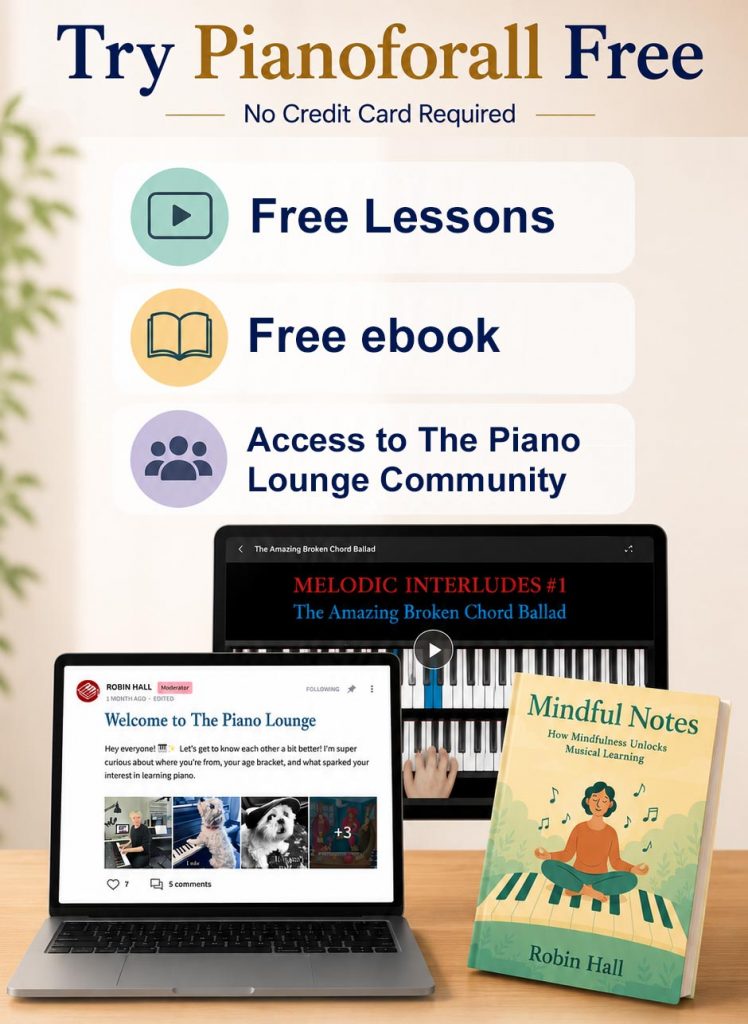
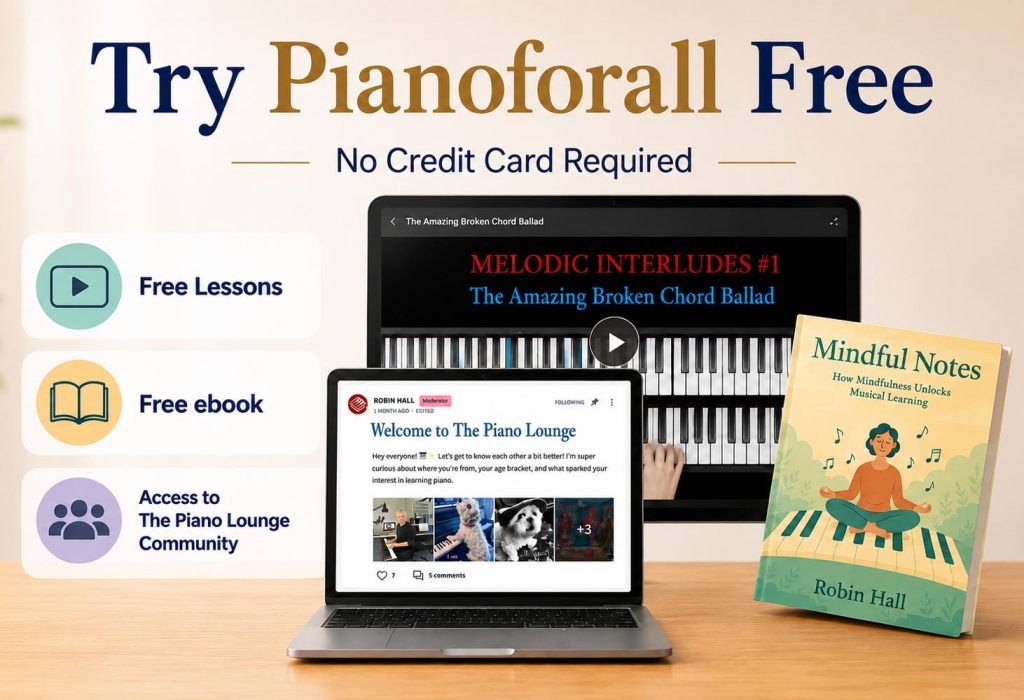
If you’d like to see how I teach those very first steps, the Free Test Drive lets you go inside Pianoforall Academy and try a lesson for yourself. There’s nothing to install or set up — just sign in and start learning.
And before you buy a keyboard — or if you’re wondering whether your current one is helping or hindering you — have a look at my Choosing a Keyboard or Digital Piano guide.